
From Curse to Cosmic Grace: The Deep Philosophy of Ram–Narada Samvad in Ramcharitmanas
1. Introduction
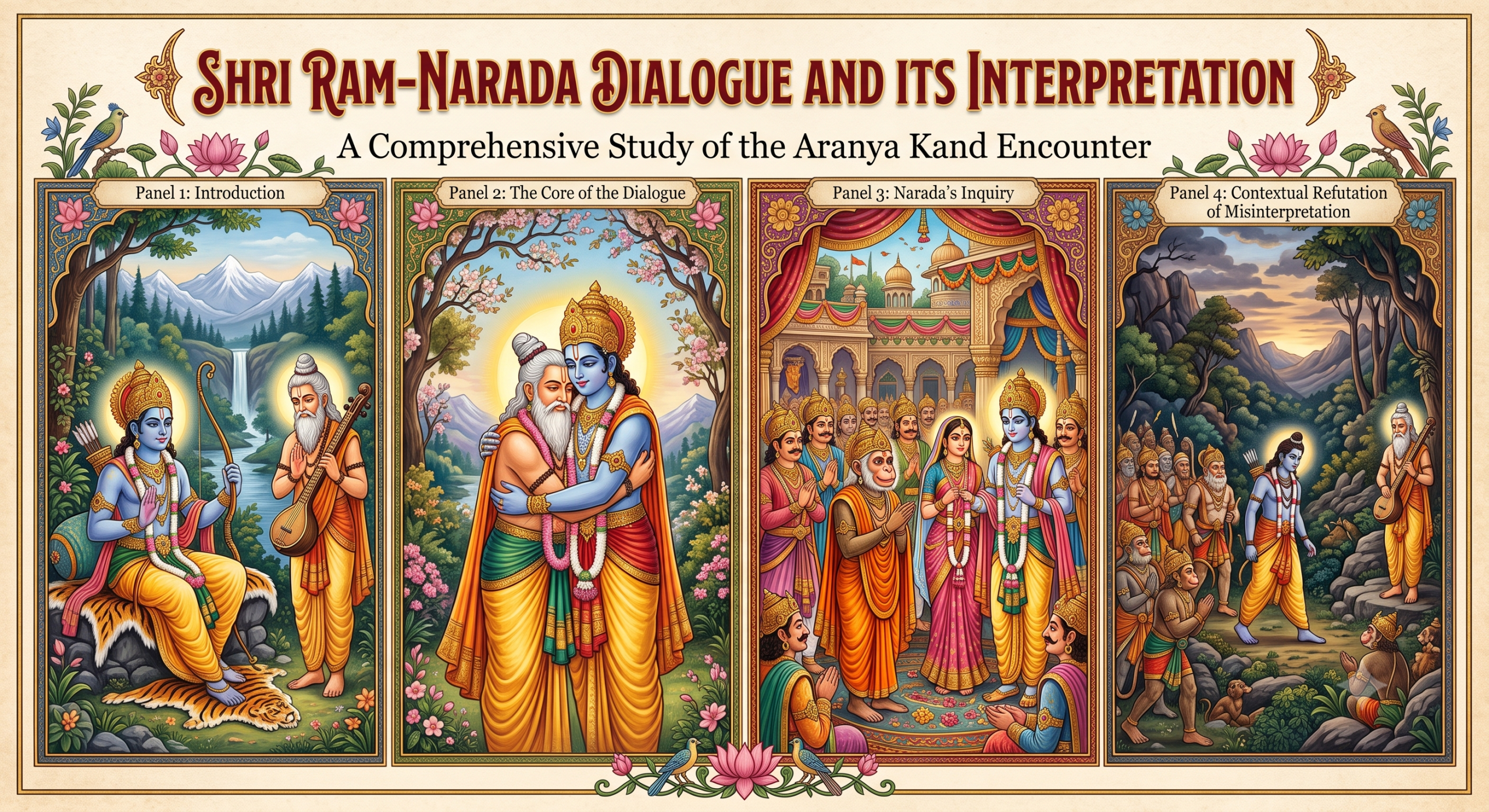
The dialogue between Lord Shri Ram and Devarshi Narada in Goswami Tulsidas’s Ramcharitmanas is one of the most profound episodes in Sanatana literature. It spans across two key cantos: the origin of divine incarnation in the Balkand (The Narada Moha episode) and the philosophical culmination in the Aranya Kand (Post-Shabari and Pre-Kishkindha episodes).
When approached purely with modern literalism, parts of this discourse can be misunderstood. However, a deeper philosophical examination reveals that it is an exposition on spiritual discipline (Vairagya), the dangers of subtle spiritual ego (Abhimana), the nature of cosmic illusion (Maya), and the unmatched grace of Bhakti (devotion).
2. The Prelude: Spiritual Ego and the Curse (Balkand)
To understand Narada’s visit to Shri Ram in the forest, one must look at the foundational narrative in the Balkand:
- The Conquest of Kamadeva & The Rise of Pride: Narada performed rigorous austerities in the Himalayas. Lord Indra, fearing Narada’s power, sent Kamadeva (the deity of desire) to distract him. Narada remained unaffected. Instead of viewing this as divine grace, Narada harbored subtle pride: “I have conquered lust.” He boasted of this feat to Lord Shiva, Lord Brahma, and finally to Lord Vishnu.
- The Illusion of Vishwamohini: To cure His dear devotee of the destructive spiritual disease of pride (Mada/Ahankara), Lord Vishnu created an illusory kingdom ruled by King Sheelanidhi, whose daughter Vishwamohini (an embodiment of Lakshmi) was holding a Swayamvara. Narada was instantly infatuated, forgetting his centuries of renunciation.
- The ‘Hari-Mukha’ and the Swayamvara: Desiring to marry her, Narada prayed to Vishnu: “Prabhu, give me your form (Hari-mukha) so that the princess chooses me.” In Sanskrit, Hari means Vishnu, but it also denotes a monkey (Vanara). Out of compassion to protect Narada’s ascetic vow, Vishnu granted him the face of a monkey while keeping the rest of his form royal. At the assembly, Vishwamohini bypassed the monkey-faced Narada and garlanded Vishnu. The attendants of Shiva (Shiva-ganas) mocked him.
- The Curse and its Acceptance: Realizing what had happened upon seeing his reflection in water, an enraged Narada cursed Vishnu:
- Human Incarnation: “You made me yearn for a woman; you too shall take birth as a mortal human.”
- Agony of Separation: “You will suffer the acute pain of separation from your wife.”
- Aid of Vanaras: “Since you gave me the face of a monkey, only monkeys (the Vanara army) will assist you in your distress.” Lord Vishnu smiled and accepted the curse gracefully, withdrawing His Maya. Overcome with remorse upon realizing his delusion, Narada repented, but the Lord assured him that this curse would serve the cosmic purpose of ridding the Earth of demonic forces.
3. The Forest Encounter: Remorse and Philosophy (Aranya Kand)
In the Aranya Kand, after the abduction of Sita and the liberation of Shabari, Lord Ram is seen wandering through the forest. Devarshi Narada arrives to behold the Lord. Witnessing the Supreme Divinity enduring mortal grief and separation, Narada experiences deep remorse (Glani), feeling personally responsible for the Lord’s suffering.
The Core Dialogue and Verses (चौपाइयां एवं भावार्थ)
Narada’s Wonder and Inquiry: Narada asks why the Lord prevented him from entering matrimony when he was infatuated with Vishwamohini:
कपि तनु धरि हम कीन्ह उपाई। सोइ सब कीन्ह चहहिं रघुराई॥
कारन कवन नाथ मोहि रोका। कीन्ह विवाह न तजि कुल लोका॥
The Lord’s Explanation of Grace and Protection: Shri Ram explains that just as a loving mother guards her infant child from harm, the Lord directly protects those who have unconditionally surrendered to Him (Ananya Bhakta):
सुनु मुनि तोहि कहउँ सहदाना। भजहिं जे मोहि तजि सकल गुमाना॥
जिमि सिसु तन मन लावै माई। तस मैं राखउँ जनहिं बचाई॥
(“Listen, O sage, I reveal the truth to you: those who worship Me abandoning all pride, I protect them just as a mother guards her little infant who has no other refuge.”)
The Lord elaborates on why He shielded Narada from household entanglement (Samsara):
काम क्रोध मद लोभ सब नाथ नरक के पंथ। सब परिहरि रघुबीरहि भजहु भजहिं जेहि संत॥
जन कहँ मोह करइ नहिं माया। मैं तेहि राखउँ जिमि निज छाया॥
4. Contextual Analysis: Refuting the “Anti-Female” Misconception
When Lord Ram speaks about the dangers of attachment to women during this dialogue, critics sometimes mistake it for misogyny. Classical commentators (Acharyas) emphasize three contextual pillars:
- “Stri” as a Metaphor for Worldly Attachment (Maya): In Vedic and Advaitic philosophy, words like Stri-Kama or Kanchan (wealth) symbolize sensory attachment, material security, and worldly delusion. Since Narada was a lifelong celibate ascetic (Sannyasi), the Lord warned him specifically against the internal trap of lust and household entanglement, which derails monastic pursuit.
- Internal Weakness vs. External Entity: The warning is targeted at the mind of the seeker (Sadhaka), not at women as human beings. Desire (Kama) is an internal agitation of the ego that projects itself externally.
- The Elevated Position of Women in Tulsidas’s Work:
- Shabari: In the same Aranya Kand, Lord Ram explicitly instructs Shabari in the ninefold devotion (Navadha Bhakti), asserting that neither caste, gender, nor lineage matters in devotion: “जाति पाँति कुल धर्म बड़ाई। धन बल परिजन गुन चतुराई॥ भगति हीन नर सोहइ कैसा। बिनु जल बारिद देखइ जैसा॥”
- Anasuya & Sita: Anasuya is presented as the epitome of spiritual wisdom and steadfastness; Sita is revered as the Adi-Shakti (primordial cosmic energy).
5. The Hallmarks of True Saints (संत-लक्षण)
Before concluding the dialogue, Narada asks Lord Ram to enumerate the characteristics of true spiritual beings (Sants). Shri Ram describes them as:
- Free from the six inner enemies (Kama, Krodha, Lobha, Moha, Mada, Matsarya).
- Devoid of pride, harboring universal compassion for all living creatures.
- Steadfast in righteousness, finding supreme joy solely in the divine name and selfless service.
6. References / संदर्भ
- Shri Ramcharitmanas by Goswami Tulsidas (Gita Press, Gorakhpur) – Balkand (Dohas 125–138) & Aranyakand (Dohas 41–46).
- Adhyatma Ramayana – Aranya Kanda, Chapter 10 (Narada-Rama Samvada).
- Valmiki Ramayana – Uttara Kanda & Aranya Kanda.
- Kalyan: Shri Ramcharitmanas Visheshank (Gita Press).
Dr. Amit is a seasoned IT leader with over two decades of international IT experience. He is a published researcher in Generative AI and chatbot architectures (Springer & IJAET), with a PhD in Generative AI focused on human-like intelligent systems.
Amit believes there is vast potential for authentic expression within the tech industry. He enjoys sharing knowledge and coding, with interests spanning cutting-edge technologies, leadership, Agile Project Management etc. He previously earned top honors in his MCA.